Camp Reed; Sandy Hook, Maryland
August 23rd - September 2nd 1861

Illustration of Harper's Ferry by Charles Roundy, Company F.
Table of Contents
- Introduction
- Charles Roundy Manuscript; Harper's Ferry & John Brown
- The Regiment moves to Sandy Hook
- Description of the March To Sandy Hook & Wounding of Edwin Smith.
- Two Letters of James Ramsey, Company E
- Sandy Hook - Life in Camp
- Skirmish at Beller's Mill; September 2nd 1861
Introduction
Sandy Hook, Maryland is situated on the Potomac River a mile east of Harper's Ferry, West Virginia. Major General Nathaniel P. Banks established his army's headquarters at Sandy Hook when he assumed command of the Department of Shenandoah in late July, 1861. Banks moved his camp further east to Darnestown, Md. in August. Colonel Leonard's regiment was ordered to Sandy Hook August 21st. They camped here until September 3rd.
The regiment marched past Sandy Hook to Harper's Ferry, left companies I & K posted there to establish a picket guard, (Captain R. L. Shriber in command), then marched back to Sandy Hook and pitched tents. The extra marching caused some grumbling in the ranks. The 13 mile march of August 23rd "was "needlessly prolonged 2 or 3 miles by our marching past the place we were to encamp upon." Before the evening was out, they would rush back to Harper's Ferry again.
That night, (Saturday, August 24th) skittish Captain Shriber raised the alarm. Confederate cavalry appeared at Harper's Ferry and Shriber sent for re-enforcements. "We all rushed out pell mell, and ran the whole distance, (1 1/2 miles), double-quick to the rescue of our comrades;" so wrote "A Chelsea Boy" in a letter home describing the event. The young volunteers were eager to enter the fray. At this particular skirmish it is reported one rebel horseman was shot.
Edwin Smith Wounded
During the excitement Edwin Smith of Company K was badly wounded by his comrades in a sad accident. Smith was sent to convey some information to four lookouts posted on a hill. The lookouts fired upon Smith before properly challenging him with, "Who comes there?" Smith lingered in a hospital nearly two years before he died from his painful wound. His wounding cast a deep gloomy over the company.
 Relative Quiet
at Sandy Hook
Relative Quiet
at Sandy Hook
In the morning (August 25th) the body of the regiment returned to camp at Sandy Hook. Companies F, G, and H were sent out during the week to guard portions of the C & O canal. Things remained quiet in camp, until September 2nd, - all the action was at Harper's Ferry. Its interesting to note the optimism prevalent in the letter of James Ramsey, "The Colonel says we will all be home in 3 months." (Colonel Leonard, pictured right). The most notable event in camp was the arrival of the state issued uniform coats and hats for the soldiers. Few of the articles fit, and the unpopular hats immediately began disappearing.
The soldiers were treated to a light show the night of August 31st when the "Northern Lights" flashed across the sky. Private John B. Noyes wrote, "Last night about 12 [o’clock] a splendid meteor fell from the sky carrying a train as large as a cable, gradually increasing in brilliancy till it burst behind the Virginia mountains with a light momentary in duration like that of a conflagration." Private James Ramsey mistook the lights for rebel signals, "about midnight I saw a blue rocket in Virginia towards the south east near morning some sentinels saw a red one and then a green one towards the south west probably they were signals of the rebels."
Engagement of Beller's Mill September 2nd
The quiet in camp at Sandy Hook was contrasted by the frequent skirmishing at Harper's Ferry.
"The gallant
13th kept up a constant fire on the
few inhabitants of
Harper's Ferry, suspecting or affecting to suspect them of being
rebels. Everything that moved about the streets they shot at
vindictively. The appearance of even a mullein leaf swaying
in the wind elicited a volley from these ever vigilant guardians of the
nation;" so wrote Harper's Ferry historian Joseph Barry.
Indeed the troops opposite the town
arrived shooting. Loyal citizens of Harper's
Ferry constantly warned volatile
Captain Shriber of impending attacks. Emotions ran
high on both sides of the river at this early stage of the
war. September 2nd, Shriber marched Companies I & K
to a mill a couple miles into Virginia. They confiscated some
grain and returned through the town of Harper's
Ferry. Rebel cavalry showed
up on the hill above the town and fired at the men of Company K, as
they were crossing in boats to return to the Maryland
side of the
river. Shots also rang down on Capt. Shriber and Company I,
who were still in the town. Shriber was sitting on the porch
of a house when the shots commenced. Joseph Barry wrote: "At
the first fire he jumped into the Shenandoah to hide behind a stone
wall that protects the Winchester and Potomac railroad from the strong
current of the river. Although he effectually shielded
himself against fire, he was not equally successful against the river
which at this place is both deep and rapid and he had much difficulty
in saving himself from being drowned. As it was, his fine
clothes were much damaged and a red sash, which he wore around him,
left a stain on his uniform which could not be removed by any amount of
washing it." Although they pretended otherwise
in letters home, the men of Company I soon lost faith in Captain
Shriber.
George Brown of Company I was wounded in the hand at this engagement. The rebels lost one or two killed and about four wounded. The Confederate cavalry was probably that of famed Lt. Col. Turner Ashby, C.S.A.
Departure for Darnestown
The next day, September 3rd, seven companies of the regiment broke camp at Sandy Hook and left for Darnestown. Companies C, I and K, were left behind as an official detachment commanded by Major Gould.
NOTE: Joseph Barry's account is from his 1903 book,"The Strange Story of Harper's Ferry." More information about Captain Shriber and Beller's Mill can be read on the "Nine Weeks at Harper's Ferry" page.
Picture Credits: Charles Roundy Manuscript, from Army Heritage Education Center, (AHEC) Carlisle, PA; Col. Leonard, & Views of Harper's Ferry are from AHEC, MOLLUS Massachusetts Collection, Carlisle, PA; View of Shenandoah Street from Historic Photo Collection, Harper's Ferry NHP; Lt. Bacon from private collector; Photo of regulation hat by Brad Forbush; all other images, Library of Congress. All images have been altered in Photoshop.
Charles Roundy Manuscript; Harper's Ferry & John Brown
Sandy Hook is across the river and down a mile from Harper's Ferry. When they moved to this place August 23rd, the soldiers of the 13th Mass could not help but think of John Brown and his famous raid on that town in October, 1859, just two years earlier. It was a place worth seeing and writing about in letters home. Here is Charles Roundy's account of events.
To attempt to tell of the causes of the Civil War and why we left our peaceful homes to become soldiers would be incomplete if we left out the name of slavery's bitterest enemy - John Brown. In Kansas he fought and his sons with him to make Kansas a free state, his life was devoted to blotting out the curse of slavery - he saw one of his sons murdered by ruffians set on by slave-holders.
His schemes to free the slaves were wild and without reason, But underlying all, and all laws opposed to him - He was Right. he was called a crazy fanatic, and all the other names that go to discredit a reformer, willing to give up life itself for its ideal.
- So also were our forefathers called when they rebelled against the might of Old England - Rebels - Traitors, and undutiful Children.
In October 1859 he, with a band of seventeen men - camping among the mountain caves along the Potomac and in Virginia, decided to sieze the United States Arsenal at Harper's Ferry, Virginia, and secure the muskets stored there and arm the slaves and thus have them help to secure their own freedom, like all such reformers he was an intensely religious man and believed what he was doing was Right in the sight of his God.
There was no sense in the plan for the Whole Country was bound hand and foot by laws, to Keep the black man a slave, and even hunt him down and return him to his owner should he escape.
John Brown would have died in his tracks before he would uphold or help sustain such a law.
He and his men siezed the Arsenal at Harper's Ferry.
The brick fire engine house, located in
the yard of
the arsenal had a bell in its belfry, and when the bell was rung it was
to be a signal for the slaves to rise and arm themselves from the
Arsenal, and John Brown was to march at the head of his army and free
the slaves and blot out slavery.
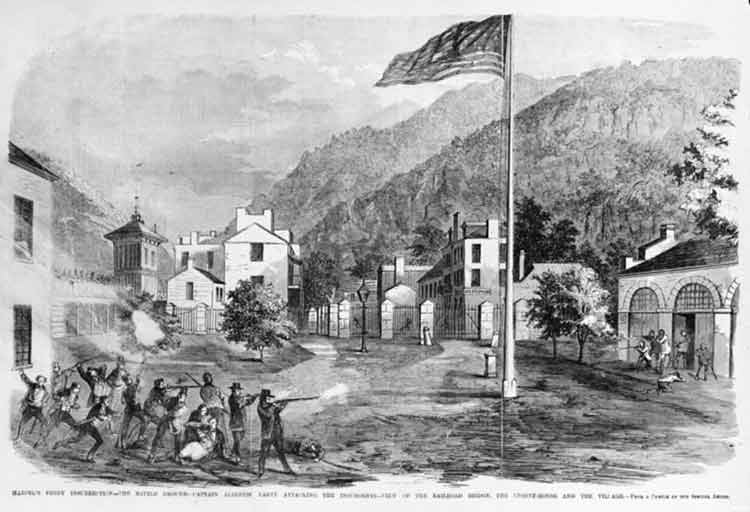
The plan failed utterly - John Brown and his men were captured by a company of United States Marines commanded by Robert E. Lee, they were taken to Charlestown, Virginia, eight miles distant and John Brown - Cook and some others were hung amidst the greatest excitement and intense bitterness towards any one who dared speak against slavery -
In my Company was a man who knew every secret hiding place in the mountains around Harper's Ferry and Maryland Heights and it was whispered that he had beeen one of John Brown's men who had escaped capture, he would point out places where he had been with Brown's band - his name was Ledra Coolidge, a quiet, earnest sort of man.
The world thought John Brown a disturber - a crazy man, a lunatic - but Wendell Phillips when he looked down into John Brown's grave said "he has abolished slavery."
The Regiment moves to Sandy Hook
Headquarters
Department of the Shenandoah,
Near Hyattstown,
Md., August 21, 1861.
Colonel Leonard, Thirteenth Massachusetts Regiment:
Sir: In view of instructions, received this day from headquarters of the Army in Washington, it becomes necessary for you to take post in the vicinity of Harper's Ferry. The Commanding General directs that you proceed with your regiment to Sandy Hook, and to take post on the Maryland side of the Potomac, so as to prevent an enemy from crossing at the ford or ferry, and to hold the Maryland Heights.
Very Respectfully,
ROBT. WILLIAMS
Assistant
Adjutant-General
From "Three
Years in the Army" by Charles E. Davis, jr.; Boston, Estes
&
Lauriat, 1894:
Friday, Aug. 23. Marched from Broad Run to Sandy Hook, fifteen miles, and camped about two miles back from the Potomac River. Co. I was detached and sent to the river, opposite Harper’s Ferry, to guard the ford at that point.
 While at Sandy
Hook we received the hats
and uniform
coats issued to us by the State, and which were forwarded by
express. The coat was much too heavy, with the thermometer in
the
eighties. It was made with long skirts, and when fitting the
wearer was not a bad-appearing garment; but as very few of them did
fit, our personal appearance was not improved. They were made large in
front, to meet an abnormal expansion of chest. Until we grew to them,
it was a handy place to stow some of the contents of our knapsack. The
hats were neither useful nor ornamental. They were made of black felt,
high-crowned, with a wide rim turned up on one side, and fastened to
the crown by a brass shield representing an eagle with extended wings,
apparently screaming with holy horror at so base an employment. On the
front of he crown was a brass bugle containing the figure 13. Now it so
happened that the person who selected the sizes was under the
impression that every man from Massachusetts had a head like Daniel
Webster – a mistake that caused most of us much trouble, inasmuch as
newspapers were in great demand to lessen the diameter of the
crown. Those of us who failed to procure newspapers made use
of
our ears to prevent its falling on our shoulders. As will be seen later
on, they mysteriously disappeared.
While at Sandy
Hook we received the hats
and uniform
coats issued to us by the State, and which were forwarded by
express. The coat was much too heavy, with the thermometer in
the
eighties. It was made with long skirts, and when fitting the
wearer was not a bad-appearing garment; but as very few of them did
fit, our personal appearance was not improved. They were made large in
front, to meet an abnormal expansion of chest. Until we grew to them,
it was a handy place to stow some of the contents of our knapsack. The
hats were neither useful nor ornamental. They were made of black felt,
high-crowned, with a wide rim turned up on one side, and fastened to
the crown by a brass shield representing an eagle with extended wings,
apparently screaming with holy horror at so base an employment. On the
front of he crown was a brass bugle containing the figure 13. Now it so
happened that the person who selected the sizes was under the
impression that every man from Massachusetts had a head like Daniel
Webster – a mistake that caused most of us much trouble, inasmuch as
newspapers were in great demand to lessen the diameter of the
crown. Those of us who failed to procure newspapers made use
of
our ears to prevent its falling on our shoulders. As will be seen later
on, they mysteriously disappeared.
Remained in camp at this place until September 2d, with the usual routine of camp duties. The farmers soon discovered we were flush with money, and raised the price of watermelons from two cents apiece to twenty-five cents. Butter, eggs, and other luxuries were displayed before the patriotic sons of Massachusetts, and many there were who were beguiled of their money, and some there were, I am afraid, who evened up by forgetting to pay; but, as Mr. Kipling says, that is another story.
Description of the March To Sandy Hook & Wounding of Edwin Smith.
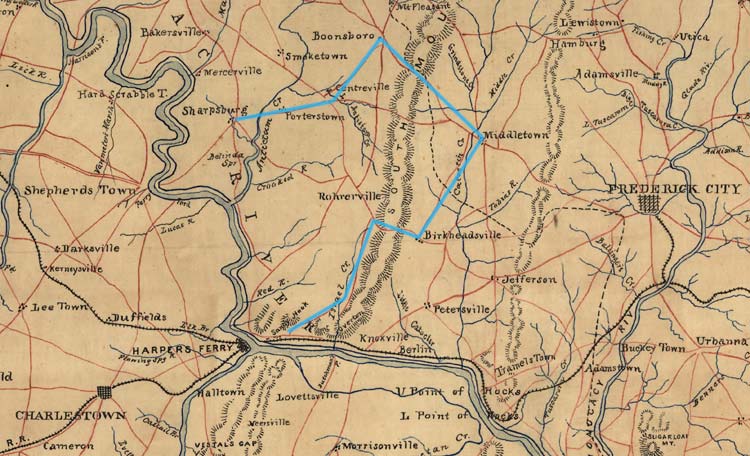
This map shows the route of march the regiment took from Sharpsburg to Sandy Hook. Before halting to make camp, the regiment marched 1 1/2 miles past Sandy Hook toward Harper's Ferry. Companies I & K were left to establish picket posts along the river opposite the town. The rest of the regiment marched back to Sandy Hook and made camp.
Chelsea Telegraph & Pioneer
Two accounts of the gun fire at Harper's Ferry the afternoon of August 24th are given in the following letters. The jealousies between the companies is already beginning to subtly show up in these letters. The Boston Companies reflected an attitude of superiority over the so-called 'country companies.' For the Chelsea Boy, in Company B, a Boston Company, the regiment double-quicked "to the rescue of our comrades," and, "kept up a fire all night." A Company K man, who was at the scene, describes the affair as a "fruitless alarm." The first letter transcription is from the defunct website "Letters of the Civil War" which was maintained by Tom Hayes. in the mid 1990's.
CHELSEA TELEGRAPH & PIONEER
Sandy Hook, Md., Aug. 26, '61.
Dear
Editor:
We left Antietam Ford last Tuesday, for Sharpsburg, a small town on the
Potomac, a place of over 700 inhabitants. Camped in the woods till next
morning, then marched to Boonsboro and slept out in a drenching rain
till 5 o'clock next morning; then started again, without anything to
eat, tired, sore and stiff, to a place called Broad Run, sixteen miles
from Boonsboro. It rained at intervals all day, and at night
it rained
in torrents. Our tents were all stowed away in the wagons; so
we had to
bivouac again in the rain. Next morning we started for this
place (13
miles more); but on arriving here had orders to march to Harper's
Ferry, distance 1½ miles. Then had to travel back again to this camp.
Cos. I and K were left at the bridge opposite the Ferry; and
at 9
o'clock P. M., a messenger arrived here stating to us that the
companies left behind were attacked by a large body of cavalry and were
in great danger of being cut to pieces. We all rushed out, pell mell,
and ran the whole distance, (1½ miles,) double-quick time, to the
rescue of our comrades; but before we had time to get there the enemy
had begun the attack, and one of our brave boys [Edwin Smith] was
shot through the
wrist and shoulder; his arm will probably have to amputated.
I also saw
one of the rebels fall at our first fire shot, through the breast; how
many more are killed I have not yet been able to ascertain. They kept
up a fire all night, but no one else was hurt on our side. This is the
second skirmish I have been in, and I wish very much to see a regular
pitched battle, in open field.
There are five Chelsea boys in this Company, (Co. B,) viz; Edwin Field, Freeman Duren, George Pomroy, Lyman H. Low, and Charles Leland. They are all well, and wish Chelsea folks could see them just as they are at present, - covered with dirt and mud after being up all night, blazing away at the enemy across the river.
We expect very soon to leave for Washington to join Gen. Banks at Point of Rocks. He is twenty miles below here, and there is not another regiment within ten miles of us. Some times we think our position rather dangerous. If we should need help, the roads are so rough it would take some time to get any assistance. It is reported that there are two regiments of rebels encamped on the other side; but we are ready to give them a warm reception if they attempt to cross to this side of the river. I do not like camp life quite as well as home, because it is very hard to get anything to eat. The last few days we would have starved, had we not got paid off by the State of Massachusetts. I do not know who is to blame, but there is a "screw loose" somewhere. I must close, as the mail leaves very soon. I will write again the first opportunity. From
A Chelsea Boy,
Co. B, 13th Regt. Mass. Vols.
(Chelsea Telegraph and Pioneer, August 31, 1861, Pg. 2, Col. 5.)
Westboro Transcript; Letter from Company K
This correspondent from Company K, reports on the wounding of Edwin Smith, and the general situation at Harper's Ferry. (Copies of the Westboro Transcript are on file at the Westboro Memorial Library).
WESTBORO TRANSCRIPT
Tuesday, Aug. 20, orders to break camp and go to Harper’s Ferry. Some thought the destination was ‘Richmond,’ some Sandy Hook, some thought the first step forward was back to Boston, though no one knows why? No order came to start.
Next afternoon Wednesday, 21st we commenced a long march to Boonesboro, (rain in short skirmishes).
Next morning, 18 miles to Frederick to join Banks. Most Mass. boys had never seen such splendid scenery, (over the Blue Ridge), at Middletown a messenger gave an order to go to Sandy Hook so they had to retrace their steps! Marched ‘til evening. Stopped at Broad Run.
Saturday, Co. K ordered to join Co. I at Sandy Hook 3 miles from camp to guard the fords and prevent supplies from crossing the river. Stayed in abandoned (town) houses. Co. I was earlier fired upon by stray rebel horsemen.
“In the evening (of the day of our arrival) our unripe experience led us to mistake the glistening of the moonbeams upon the windows of church opposite for the camp lights of the enemy. We fired a volley into it which made work for the glaziers according to the report of the startled villagers the next morning.”
“From certain signals seen and information brought over by citizens, Capt. Schriber of Co. I was led to expect an attack and sent to camp for re-inforcements. Accordingly the remaining Companies of the regt. with 3 Pa. Companies from Knoxville came down and were all distributed along the bank of the river to prevent any possible invasion. A fruitless alarm as this was should have ended well; but it was attended with a casualty which added fearfully to the excitement ‘and cast a deep gloom over Co. K. – Private Edwin Smith ‘of ours’ was sent up to the lookout to learn what observations he had made. As he approached the sentry in the darkness, the latter without challenging, discharged successively his rifle and pistol at him. The rifle ball grazed the wrist and passed through the arm near the shoulder. At first amputation was thought to be necessary; but the glad tidings now come to us from the hospital that the patient is out of danger. Vigilant sentinels could discern no further signs of the enemy and when morning came the reinforcements retired.”
 On Monday the 26th, a squad of Co. K
men under Lt.
Bacon (pictured)
crossed the river and hoisted an American Flag upon the staff at
the ruined arsenal, where it still waves, to the great wrath of the
remaining secessionist inhabitants of the well-nigh deserted place.
On Monday the 26th, a squad of Co. K
men under Lt.
Bacon (pictured)
crossed the river and hoisted an American Flag upon the staff at
the ruined arsenal, where it still waves, to the great wrath of the
remaining secessionist inhabitants of the well-nigh deserted place.
Families are daily moving across the river with their goods bound for the interior of Maryland and the north. They represent the rebels to be exercising dominant power over all the inhabitants, impressing into the rebel army all who from want of means are unable to leave and they fear they will soon occupy the place in strong numbers.
Our companies are now engaged in putting our position in the best possible state of defense. Canon are to be placed upon the mountains. The fords in the upper river destroyed, rifle pits dug, and river craft taken possession of. Scouting parties daily up and down the river daily for this purpose adding greatly to the interest and pleasurable excitement of being stationed here.
The 13th Regt. can truly consider it no small feather in its cap that to it, is assigned the honor of defending so important and dangerous a post.
But at this moment the drum rolls out, the diner call, sounding so loud in my ears that this lengthy letter must give way and allow me to subscribe myself.
Yours for the War-
NOTE: Sadly Edwin Smith never recovered from his wound. Sergeant Austin Stearns wrote in his memoirs Three Years with Company K,"They took Smith down to the Regiment, after which he was sent to the hospital at Baltimore. He lingered about two years, dying from the effect of the wound. He was the first man of the Regiment hit by a bullet."
Two Letters of James Ramsey, Company E
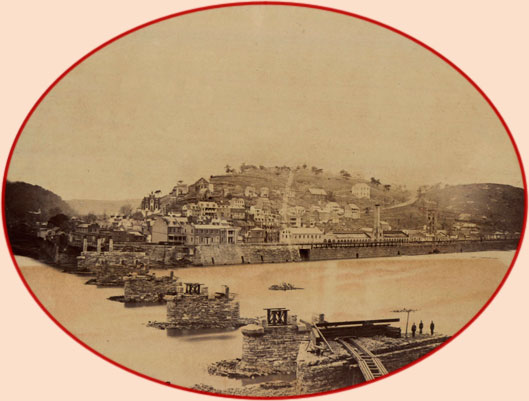
View of Harper's Ferry from Maryland. The Rebel army destroyed the arsenal buildings and railroad bridge in June, 1861 before evacuating town. The arsenal buildings are visible on the right. Bolivar Heights is the hill above the town.
Sandy Hook. Aug. 24th 1861
Dear Mother.
I am very well I am perfectly contented now. When I wrote to you last I was about 8 miles further up the river but last Tuesday we had orders to go to Washington we marched to head-quarters at Sharpsburg and joined the regiment that afternoon, next evening we started for Boonsborough where we encamped till next morning and then marched to Middletown a distance of 23 miles from Sharpsburg we encamped about 3 miles from Middletown at a place called Broad Run on the road to Sandy Hook over night next morning we started for Sandy Hook a distance of 12 miles where we are now encamped. We traveled a distance of about 38 miles to go to a place about 8 miles from where we were before. When the regiment started I had a sort of a disentery but now I am entirely well. We heard that there was a report that some of our regiment was taken prisoners but the report is false we are all safe and well. Yesterday I had a good view of Harpers Ferry from across the river. I saw the government buildings that were burnt. I do not think that it is much of a place. It is quite small for a town. It is a splendid view from the mountains. It resembles the picture in the geography some. We are encamped where the twelth was encamped it is a splendid place. I cannot think of much to write now. I must bid you good by. Give my love to all, kiss Bertie for me. I have not received but two letters since I have been from home. Last Monday we were paid 5 dollars
Good by from your
Son James.
P.S. Do you get my letters with the old postage stamps on write and tell me soon.
P.S. By the way I
direct most of the letters for the men.
Running Messages
Sandy Hook Sept. 1st 1861
Dear Mother
I am very well. I thought I would write to you although I have not received a letter from you since I got the boxes. I received Ella’s letter day before yesterday she wrote that you was a going to write and that you had sent a paper. I have received no paper. When you write next I wish that you would send me some new stamps in the letter. I am all out and cannot buy any. When I wrote to you last I was in Pleasant Valley but our company was sent to the village of Sandy Hook to act as a telegraph between the companies at Sandy Hook opposite Harpers ferry and head quarters. It takes half of the company every day. I was on yesterday and last night, we stand at our posts six hours at a time, we run with messages from our posts to the next and he runs to the next man and so on till the message gets through. I run with four messages yesterday morning. I did not have to run in the night, about midnight I saw a blue rocket in Virginia towards the south east near morning some sentinels saw a red one and then a green one towards the south west probably they were signals of the rebels. Our quarters are situated on the canal at one of the locks, this morning. I had a ride on one of the canal boats while it passed through the lock. A canal boat does not look any thing like the pictures I have seen of them. By the way the canal is the Ohio and Chesapeake canal. At the time of writing this letter I am sitting in the shade of an oak tree between the canal and the Potomac river on the toe path. In front is the Virginia bank of the Potomac the river at this place is full of rapids. I am near the gap in the mountains, on my right hand is Harpers ferry the parts I can see is principally dwelling houses and one church that sets on the hill, the river at that place makes a curve towards the north west and the mountains in Maryland hide the rest of Harpers ferry from my view. I did not seem to like the place when I wrote to you before but now I have formed a very different idea of the place since I went up the river that night and saw the government buildings about half of the works are burnt. I should think they extended about an eighth of a mile along the bank of the river the parts that remain perfect are very handsome, since I have seen some of Harpers ferry I call it the handsomest town that I have ever seen. Charles Gardner and Joseph Halstrick are both well. Give my love to all kiss Hugh for me.
Good
bye from
Your
son.
James.
Dear sister Ella
I thought I would answer that letter you sent to me the other day. I am glad that you take an interest in me to write to me once and a while and I will try and answer them if I can. Tell mother I have got all of the letters and boxes she has sent to me. I am sorry to hear that John McCrillis has run away. I know if he goes to war he will repent it. Yesterday when I was on guard I saw two little boys about four years old playing horse with sticks and it put me in mind of Hugh and that they were seeing the happiest days of their life. Last night some of companie I’s men went over to Virginia and took two men and three horses. It is about half after one when I had written about half of mothers letter I was called to dinner we had bean soup and hard bisket for dinner. I expect to go to meeting this afternoon to hear our chaplain he is a very nice man he is liked by all of the men he looks out for their earthly well fare as well as their spiritual welfare you must excuse that spelling. The Col. says we will all be home in three months.
Give my love to all
Good
bye from your
Brother
James.
Sandy Hook - Life in Camp
CAMP REED, SANDY HOOK,
Aug. 29, ’61.
FRIEND H. – I thought I must keep myself in remembrance to you by scribbling a few lines. Life is dull here – nothing to do, and plenty of it. This is the place, as you are aware, where Gen. Banks’ headquarters were, and where Col. Gordon’s regiment was stationed after Banks’ moved down to Point of Rocks. Lawyer’s sons are good fellows, some of them, and their money is good too, but they can’t keep a good hotel on Sandy Hook. We have got one of the General’s most important situations to take care of, and we mean to do it. I don’t apprehend much fighting here, although we have a dangerous and important position. The 2d Mass. regiment, as the story goes, were a little scare[d?] while here.
The 13th, I think, has done as much important guard duty as any regiment in the field, to say nothing of the marching they have done. Our regiment is pretty well scattered again. Five of the companies are stationed along on the canal from Harper’s Ferry to Berlin, a distance of six miles. Speaking of the Ferry, just as soon as our troops left, the rebels came down and begun to put on airs, but when we marched down, you had ought to have seen them leave. We have seen but very few. We have exchanged shots with them a few times, and our boys think they have killed a few. We know we have shot one of their horses, but we don’t know whether we have hurt their riders or not. They had better keep out of the way of those Enfield guns, if they don’t want to get hurt.
One of our companies has left to-night, and probably another will go to-morrow. They boys are in tip-top health, and engage in all kinds of amusements. They have a circus and menagerie every night, and you would be amused to hear the door keeper address the outsiders on the wonderful performances of the animals.
I would give something to have you step into our camp and see us. My tent is a comfortable place to live in. I have got a nice cot-bed, which I have made, and it is just the thing to sleep on. I have a dry goods box for a table, am writing on it now, and it serves my purpose well.
One of our companies is marching out of camp to some place assigned them, and it is very dark; all of the companies are away, with the exception of the original five that were the nucleus of the 13th. We are keeping guard on the canal. Sentinels are posted for twenty or thirty miles, and about 200 paces apart – if anything should happen the word is passed along lively. The band, stationed in front of Col. Leonard’s tent, has just commenced to play, and the music sounds sweetly, reminding me when with my sweet-heart, we used to go and hear them on Boston Common.
Items are scarce, but I hope to have something interesting in the next.
Yours, PONEY.
Digital transcription by James Burton
Letter of John B. Noyes, Company B
Noyes comments on the food in camp and the fighting at the ferry. On Sept. 2nd he mentions two companies were sent from camp to the support of Capt. Shriber (also Screiber) at Harper's Ferry,
Ms Am 2332 (71) Houghton Library, Harvard University. Used with Permission
Pleasant Valley Md near Sandy Hook Sept 1, 1861
Dear Charles your absence from Brighton during your vacation deterred me to defer writing till the end of August. Yesterday being on guard I took my portfolio to the guard tent with the expectation of penning a few lines, but concluded to doze instead – doze while off duty I mean, for sleep on my post I hope will never be my chance-luck. Last night about 12 % [o’clock] a splendid meteor fell from the sky carrying a train as large as a cable, gradually increasing in brilliancy till it burst behind the Virginia mountains with a light momentary in duration like that of a conflagration. When the news of the taking of the arsenal at Harpers Ferry electrified the country, more than a year ago I little thought that on the night of the 24th of August 1861 I, a soldier should see the ruins of the arsenal and rejoice thereat. Yet such is the reality. I saw the ruins extending along the line of the Potomac for a long distance made doubly famous by the feats of Brown & Jones. Robinson had not yet appeared upon the stage. Perhaps he may be the man on the white horse whom Cushing saw in his vision of a year ago or so. My letters to father will have sufficiently pointed out the chief features of my journeyings so that I need not take up space in the narration thereof. Now we have but four Companies in camp. Those of the 4th Battalion, a fact which did not occur to me till this moment. After all our vicissitudes we are now here solitary and alone. The other companies are guarding fords up and down the river. Screiber’s Company at the Ferry have popped a few secessionists with no loss to themselves though they have been fired upon several times. [Chaplain] Gaylord told us a day or two ago to take heed of ourselves both in body & mind, and I suppose you would like to know how we do so.
I have had plenty of wholesome
food to eat though at some cost to myself since I was paid off ???
Antietam about 3 weeks ago. From some cause not sufficiently
explained we had no allowance of rice and beans & those
articles of diet which I once thought were to be as common as bread
have been as rarely had as at home. The absence of the 2
kinds of provisions make our morning ration a rather slim affair, mere
bread & coffee and perhaps a piece of cold beef if you are
hungry. Bread & milk, eggs, pies, cakes, fruits
& vegetables make such meals endurable. At tea we
occasionally have a beef-steak which goes off “right smart I reckon” as
they say here. The rations are not yet what they should be,
but no one goes hungry.  When a chicken can be had for
sixteen cents,
eggs boiled for 15 cents per dozen, tomatoes, pears, apples, two for a
cent, pies of all kinds for 10 cents, & biscuits and butter are
“right cheap” there is no danger of moneyed soldiers
starving. Tea is not given as a ration. I miss your
pear & summer squashes however, in place thereof til lately I
had boiled corn, I need not say foraged. But the Col. shut
down on this luxury a few days ago. Water melons here are
plenty and good, brought from Baltimore. Any stories about
drunkiness among our officers & men are all
moonshine. I haven’t seen a drop of liquer since I reached
this place, and at no time, save perhaps after our first arrival at
Pleasant Valley nearly a month ago have we had a chance to get much
strong drink. One or two men may perhaps get tight on the
sly. But this is uncommon.
When a chicken can be had for
sixteen cents,
eggs boiled for 15 cents per dozen, tomatoes, pears, apples, two for a
cent, pies of all kinds for 10 cents, & biscuits and butter are
“right cheap” there is no danger of moneyed soldiers
starving. Tea is not given as a ration. I miss your
pear & summer squashes however, in place thereof til lately I
had boiled corn, I need not say foraged. But the Col. shut
down on this luxury a few days ago. Water melons here are
plenty and good, brought from Baltimore. Any stories about
drunkiness among our officers & men are all
moonshine. I haven’t seen a drop of liquer since I reached
this place, and at no time, save perhaps after our first arrival at
Pleasant Valley nearly a month ago have we had a chance to get much
strong drink. One or two men may perhaps get tight on the
sly. But this is uncommon.
Sept. 2d. As for the mind my mess is quite a good one. There is little swearing and most of the men are quite intelligent. The bible is read nightly before taps. My Shakespeare comes into play. A member of Company A carries it for me for the privilege of reading it. Papers are quite common. Baltimore papers are brought here on the day of publication.
To day we expect to leave Pleasant Valley to join some bodies, I don’t know whose, Brigade. Perhaps we are to go to Bank’s Headquarters. This afternoon Lorver (?) Screiber has surrounded a band of Secesh home guards at Harper’s Ferry, and two companies have left to secure the Rebels. They have not yet returned. To day I received some letters from Home. Father seemed to be somewhat troubled that a letter of his with money had not reached me. I suppose he has now received a letter from me acknowledging the receipt of the money. Tell him that all his letters have come safely. As for health I find that I am quite up to the average. I have not been incapacitated from duty by reason of sickness. I have been troubled more by the fleas I fell in with at Antietam than from any other cause, but have now got rid of them. They made a “right smart” attack upon us while there.
When I have another opportunity I will again write. In the meantime send me a letter & newspaper occasionally with love to Mary & baby I am Yours Truly
John B. Noyes.
Skirmish at Beller's Mill; September 2nd 1861
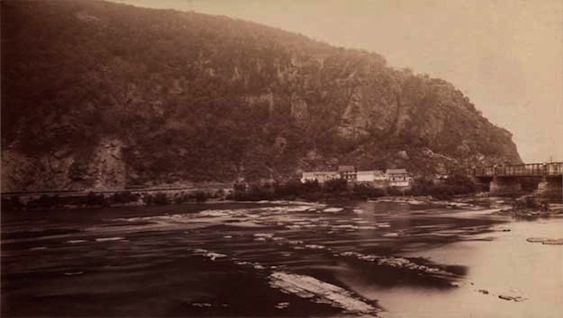
Pictured is the cliff of 'Maryland Heights' across the river from Harper's Ferry. Companies I & K were headquartered in a store among the cluster of buildings nestled against the cliff in this picture. Lock 33 of the C & O Canal is here. Rebels took pot-shots at members of Co. K, crossing in boats to the Maryland side during the skirmish of Beller's Mill.
The Company I author of the following letter, addresses the rivalry between companies by stating 'the 4th Battalion (from Boston) are not used any better than the other companies." He then expresses faith in the abilities of Captain R. L. Shriber, (Capt. Co. I) The September 2nd skirmish at Beller's Mill is mentioned briefly toward the end of the letter with the passage, "Yesterday Capt. Shriber took a party of us..."
WESTBORO TRANSCRIPT
Sept. 3. 1861
A member of Co. I., 13th Regiment M.V. now at Harper’s Ferry, writes to a friend in Marlboro relative to the fare and treatment of Col. Leonard’s command :-
“We are all well, with one exception, - wounded. Since the first three or four days we have got along finely for food. To satisfy you that we are not starving, I assure you that on leaving home I weighed one hundred and seventy-four pounds; yesterday I weighted one hundred and ninety pounds avorrdapoise ! and can sleep as well now on a pile of rocks as on a feathered bed.
The 4th Battalion are not used any better than the other companies, and, perhaps, not as well as Co. I, which undoubtedly stands at the head of the Regiment as the best company.
We like Capt. Schriber very much. His men would do anything for him. Col. Leonard is also liked by our company; much better than at first. Also Orderly Sergeant Whittier.
We are now situated on the Maryland side of the Potomac, opposite Harper’s Ferry. Here is some of the most romantic and picturesque scenery imaginable, but which my poor abilities can never describe. Suffice it to say that, in my judgement, the great Jefferson was right when he said that it was a sight well worth a journey across the Atlantic in a sailing vessel to behold.
We were located a short time since, at the confluence of the Shenandoah and Potomac, under a perpendicular cliff three hundred and seventy-five feet high! It was here the bridge over the Shenandoah was built which was burned by the rebels some two months ago. We are now in a very exposed position. The rebels could clan us out in a few minutes if they had a couple of cannons and a little spunk. There are only two companies here now, the others being all ready to leave for near Washington, where a big fight is expected soon.
As to work, I can give you a specimen in my experience. A few days ago I was officer of the day, and, of course, had to go the “grand rounds” to inspect the guard. To do it I traveled nine miles! – a very good walk after midnight and very dark at that; but I like it tip top. A few days ago a party of us went over the river, - fired into a party of rebel cavalry, shot one horse, cut off his tail, marched to the top of a high hill near the village of Bolivar, Va., - seccesh – gave three cheers for the Union and vamoosed.
Last Saturday night we went to Loudon county, - started at 9 P.M., took three horses, two men, and one gun and returned at 2 A.M. The night was very dark and it was quite dangerous; but I like it.
Yesterday Capt. Schriber took a party of us, - went over to Harper’s Ferry, were attacked by cavalry, who wounded one of our men – George Brown of Southboro, - but immediately fled, minus two killed and five severely wounded. Brown was struck in the fleshy part of the arm and in the thigh, but no bones broken.
Why don’t somebody write to us from home? Are we because ‘out of sight, out of mind’ ? I have written four letters home but have received no answer. Your letter was thirteen days reaching me, but that need not deter you from writing again soon, and in all cases direct to me “Gen. Banks’ Division, 13th Regiment, Co. I. M.V. Washington, D.C.”
Westboro Transcript; Letter from Company K, September 9, 1861
This letter, from a Company K man, gives a strait-forward account of the skirmish and continues on with news from the ferry for the week of Sept. 9th. (Companies I & K were officially detached at the ferry on Sept. 2nd). The author states Col. Turner Ashby commanded the Rebel Cavalry.
WESTBORO TRANSCRIPT
September 21, 1861
Regular Army Correspondence, No. IV.
Sandy Hook, Md., Sept. 9th 1861.
Messrs. Editors: As far as my experience goes ‘Regular Army Correspondents’ serving in the ranks, too often find the regularity of their communications disturbed by unexpected orders, marches, etc. Don’t you find it so?
To night, (or this morning – it being 12 ½ A.M.) I am an occupant of the guard house! Not as a prisoner, however, but as an officer of the guard; while five members of Company K., bound prisoners of Morpheus, lie stretched upon the floor beside me.
The telegraph and papers must have furnished you ere this, with their account of our skirmish with the rebels at Harper’s Ferry on Monday last. Though we troubled the ‘seceshers’ a trifle, the newspaper reports give us rather more credit than we deserve, perhaps. During the forenoon of Sept. 2d both companies stationed here (I and K), crossed the river as a guard while grain was being procured, marching about a mile and a half into Virginia, to a mill. After a halt of two hours, Company was ordered to return to advance and recross the river first. As they marched through the streets of Harper’s Ferry they sang their favorite “Hallelujah’ song.
John Brown’s body, etc.’
With the purpose, perhaps, of adding fresh fuel to the fire of the ‘Southern harts,’ if any such should happen to be beating within sound of their voices.
When two-thirds across the river, a ball came whizzing over the boat, and striking but a few yards ahead; which was the first intimation given that an enemy was upon the hills of Harper’s Ferry. A few shots were fired from the boat into the clump of bushes and yard in which the enemy were concealed, and from which a scattering fire was directed at the boat; but none of their shots hit the mark nearer than the papers hit the truth in their report of the affair. On reaching shore, the company were posted where they could command good shots if the enemy should again be seen. But the firing was now turned upon company I, who were still upon the Virginia side, at the base of the hill occupied by the enemy: whereat we were ordered to re-cross to their aid. We did so; and found them by the flag-staff at the Arsenal, they having had to retreat, with one man wounded. The two companies then formed into platoons, and taking different streets marched up the hill. Before reaching the summit, we learned that the rebel cavalry, number 30 or 40 men, under command of Col. Ashby, had retreated, taking off one man killed by a shot through the head and breast, and 4 or 5 wounded. A platoon of Company K found a loaded rifle lying in the grass, and spotted with blood, which they keep as a trophy. The ‘twenty-five prisoners’ reported taken, are minus, we not having had sufficient practice in ‘double-quick to catch up with the retreating foe. At nightfall all returned, with a detachment that had been sent to our relief.
Later in the evening, a fresh alarm started both companies up the canal to prevent any passage of cavalry across the river; and Co. K spent the time till 10 P.M., in erecting plank barricades, while Co. I remained on guard till morning. The later are now in possession of several rifles taken on a scouting expedition into Virginia the next day; and yesterday afternoon a small party of them captured a valuable horse, belonging to a rebel surgeon who had come into Harper’s Ferry to gather information, - himself escaping by a back-door arrangement.
During the week quite an amount of fatigue duty has been performed by both companies, erecting barricades, digging rifle-pits, &c., along the bank of the river, - proving to us, at least, that ‘carrying knapsack, gun and bag, ‘with the other duties of a soldier,’ is harder work than farming.’ Those who enlist to escape the drudgery of farm work must have suffered grievous disappointment ere this.
On Friday last, one of our members had a narrow escape. A spent ball from one of the enemy’s pickets passed through the side of the shed in which he was and struck him in the back; with so little force, however, that it dropped harmlessly at his heels.
Nearly every day straggling shots are fired upon our guards, and upon the canal boats, thus far without damage; and almost nightly some quaking or startled sentinel discerns signals or moving lights upon the far-off hills of Virginia, in the lightning bugs that hover but a few yards from his post; and discharge their pieces at innocent and unsuspecting swine, whose movements they mistake for the clatter of horsemen or the tramp of rebels. But no such ‘rude alarms’ now disturb the stillness of the quarters, unless the drum sounds the long roll to ‘fall in.’
Yesterday afternoon our worthy Captain Blackmer conducted Divine service, preaching a brief, practical sermon. He has officiated for the Chaplain on two or three occasions.
We are now expecting to leave this place within a few days, to rejoin the regiment who left their camp on Monday evening last, and are now within twenty miles of Washington. Our transportation will be effected by means of a scow, on the ‘raging canawl,’ a hoped-for sail of forty miles.
My next letter will probably be from ‘camp.’
Yours for the War - .
(The man wounded Sept. 2nd was George Brown of Southboro; struck in the fleshy part of the arm and thigh, but no bones broken-webmaster).

Pictured is Shenandoah Street, circa 1900. [Historic Photo Collection, Harper's Ferry NHP.] This is probably where the soldiers marched through town singing "The John Brown Song." The hill above the town where the Rebels hid out can be seen sloping upward on the right. When the shooting started re-enforcements were again called forth from camp.
At Sandy Hook, seven companies of the regiment were preparing to move to Darnestown to join General Banks, when they received the request for assistance from Capt. Shriber at Harper's Ferry. The author of the following letter belonged to one of the two companies dispatched there. He gives a few more details of the fight.
The letter writer attributes the command of the Confederates to Capt. John Henderson, who commanded a company in the 7th VA Cavalry. Henderson skirmished with the 9th NY militia July 4th at Sandy Hook. More likely, it was Lt. Col. Turner Ashby, C.S.A., who reported in September, 1861, from his camp near Halltown, "I had occasional skirmishes with the enemy in this vicinity, they having crossed twice - once at Harper's Ferry and again at Shepherdstown. I have driven them back each time without loss, having only 1 man wounded, and he doing well. I have killed several of them each time. They fire at every man, woman, child, or horse that passes the river upon this side. I have sometimes allowed muy men to return their fire with long range (small-arms) guns, wth some known effect." [Turner Ashby, Correspondence with Adj. General's Office, C.S.A., O.R., Series I. Vol. 5.]
Boston Saturday Evening Gazette
LETTERS OF THE CIVIL WAR.
SEPTEMBER 2, 1861.
Head Quarters 13th Regt. Mass. Vol.,
Camp Reed, Sandy Hook, Md.
Editor of the Saturday Evening Gazette:
Dear Sir,-Having a few moments to spare, I hasten to occupy
them in writing you a few lines; I have been so
busy the
past week that I could find no time to do so heretofore. My
last was
written from Sharpsburg. Since then we have marched a many a long mile
to arrive here were we are now. The Mass. 2d left here in a hurry,
without orders, owning to a report that large numbers of troops were
coming in at Harper's Ferry. We were en route to General
Bank's
head-quarters, when we received an order to march here to guard the
Potomac at this point. We had several small brushes with the
enemy, and
made some captures of horses and men. We now have four
captured horses
on hand. I should not have had the present opportunity to
write but for
a little excitement in the way of fighting this afternoon.
Seven
companies of Col. Leonard's command were ordered to march to
head-quarters immediately, and were nearly all ready to start when
Capt. Screiber of Co. I, commanding a detachment of two companies
stationed at the ford opposite Harper's Ferry sent a dispatch
requesting assistance, as he was engaged in a sharp fight with some
secession cavalry on the Virginia shore. Col. Leonard, with
great
promptitude, immediately sent two companies to his relief. It
seems that
the notorious Henderson really had the captain in a tight place, but
he, with the energy and ability which are so characteristic of the man,
got himself out of a bad scrape double quick. Henderson came
upon the
Bluffs in Harper's Ferry in such a manner as to look right down upon
the Captain, who was quietly sitting in a house on the opposite side of
the Shenandoah River. He sprang like a tiger through the
window, sash
and all, forded the river and marched under the enemy's fire to a
position where they could have a fair show. On gaining the top of the
hill they found there opposing force to be about 100 cavalry, well
known as the "Dogs of Henderson." Our boys charged after
them, and
killed and wounded nine of there number. They brought back
one corpse
only. From personal conversations with the inhabitants, I should say
that a number of others were dead when carried away by there comrades.
They took possession of a team on the road, and left as fast as they
could get away. Capt. Screiber has in his possession a rifle
which they
left in their haste to get off. Private George Brown, of
Southboro',
received a shot in the arm and one in the fleshy part of the thigh. The
wounds are not dangerous.
After satisfying myself that there was no more work for the day, I returned to the ruins of government property near the river. In company with Sergt. Major, Commissary Sergeant, and our worthy color bearer of the 4th Battalion, we explored the ruins, finding each of us some relics to sent home to remember the place by. By the time the other companies arrived on the ground the brave enemy were not to be found and our boys were forced to return home without any glory, except that which always accompanies a proper discharge of one's duties.
Our worthy, hard working Quartermaster, a man who works as hard to do his whole duty as any man in the 13th Regiment, is lied about and complained of by the very men who are too lazy to do anything else but growl. I may be using strong language, but the tone of several articles recently published in Boston papers prompts me to write a few lines in justice to a worthy man. The fault in regards to rations is with, and should rest upon, the commanders of certain companies from which all the growling comes. I know of two companies who have made money on their rations for some time back.
To-morrow, at 3 A. M., we leave for the Headquarters of General Banks, about 40 miles distant. We all want a chance to be in the big fight which it is expected will come off soon. We learn with pleasure of the success so far of Gen. Butler's expedition, and hope soon to hear of something cheering by land.
Yours as ever,
H.
(Boston Saturday Evening Gazette, September 14, 1861, Pg. 2, Col. 2.)
NOTE: The 'notorious Henderson' refered to in the account above, is Captain John Henderson, commissioned into the 7th VA Cavalry, June 16, 1861. He was apparently involved in a skirmish with the 9th NY (state militia) on July 4th. Henderson enlitsted at Charlestown. He was mustered into the Confederate service at Charlestown, WVA. On September 9th, Henderson was shot and severely wounded by one of his own men during an argument in regard to mustering into service. The soldier James H. Miller was tried and executed for the crime. Henderson continued to serve in the Confederate cavalry after recovering. Henderson may or may not have been involved in this fight.
Captain R. L.
Shriber
Although these reports
present Capt. Shriber's actions in a heroic light, his
leadership abilities were beginning to be questioned by those under his
command. Harper's
Ferry Historian Joseph Barry wrote:
"Sometimes the 13th would send detachments in skiffs across the river and on one or two occasions they were encountered by parties of Confederates who would occasionally lurk in the cemetery and behind the fences on Camp Hill and keep up a scattering fire on the "Yankees" in the town. In one of these skirmishes a rebel soldier named Jones was killed near the graveyard, a bullet having penetrated though the palm of his hand and then into his stomach. In this affair an officer of the 13th, whose name need not be given, very much distinguished himself. At the first fire he jumped into the Shenandoah to hide behind a stone wall that protects the Winchester and Potomac railroad from the strong current of the river. Although he effectually shielded himself against fire, he was not equally successful against the river which at this place is both deep and rapid and he had much difficulty in saving himself from being drowned. As it was his fine clothes were much damaged and a red sash which he wore around him, left a stain on his uniform which could not be removed by any amount of washing. It would appar as if a soldier's uniform eternally blushed for the cowardice of the unworthy wearer."
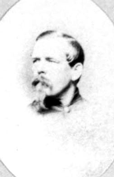
Barry also comments:
"In justice it ought to be noted that he was not a Massachusetts man by birth. His men, however, on this occasion showed a good deal of gallantry and, under Lieutenant Brown, (pictured) of the same company - his name needs no concealment - they stood their ground like good soldiers until the enemy retired."
The evening of Sept. 2nd (the day of the skirmish) Capt. Shriber again called to Col. Leonard for re-enforcements at Harper's Ferry. Informants in the town reported to Shriber that rebel cavalry were planning to cross the river in force. At the time, Leonard's seven companies of the 13th regt. were preparing to move to Darnestown, about 20 miles east, to join General Banks. Whether or not Shriber's caution was justified at the time, the supposed crossing proved to be another false alarm. Writing in hindsight, historian Charles E. Davis, jr. takes the opportunity to lampoon Capt. Shriber:
"One night before we left this camp, (Sandy Hook) the "long roll" was sounded and the regiment marched to the river, opposite Harper's Ferry, it having been given out that the enemy were attempting to cross at that ford. When near the river we were required to lie on our stomachs and crawl along so as to reach the bank without noise. We had scarcely reached the water before it was discovered that again the cause of alrarm was a pig who made sufficient noise in his wanderings to alarm the officer in command of the detachment, who thought it was the enemy. This time it was a Prussian idiot who, playing the role of Don Quixote, deprived us of a night's sleep. On the way back to camp, at daylight, he was the subject of comment, and some there were who boldly expressed a wish that he might be sent where the wicked cease from troubling." (Three Years in the Army, p. 10).
To read more about Captain Shriber, see the "Harper's Ferry" page of this website.
On September 3rd, seven companies of the 13th Mass. struck tents soon after daylight and marched with empty stomachs to the Chesapeake ad Ohio canal, where they took boats which were towed to Conrad's Ferry, enroute to Darnestown.
© Bradley M. Forbush, 2008
Page Updated March 16, 2011.
